

As a key venue for various conferences, academic discussions, lectures, reports, press conferences, multimedia teaching and training, and film screenings, the auditorium requires excellent sound quality, clear picture display, and simple and convenient centralized control. Among these, sound quality is paramount, and to achieve this, sound insulation and sound absorption must be fully considered during the design and construction phase. Proper acoustic design enhances speech intelligibility and ensures the high-quality conduct of meetings and other events. However, sound insulation and sound absorption in auditoriums involve many key aspects. Choosing suitable acoustic materials and rationally combining various materials to achieve good results often confuses many people, such as how to combine flame-retardant soft panels and porous sound-absorbing panels. Below, based on years of experience in auditorium acoustic design at Tiange Acoustics, we will provide detailed answers.
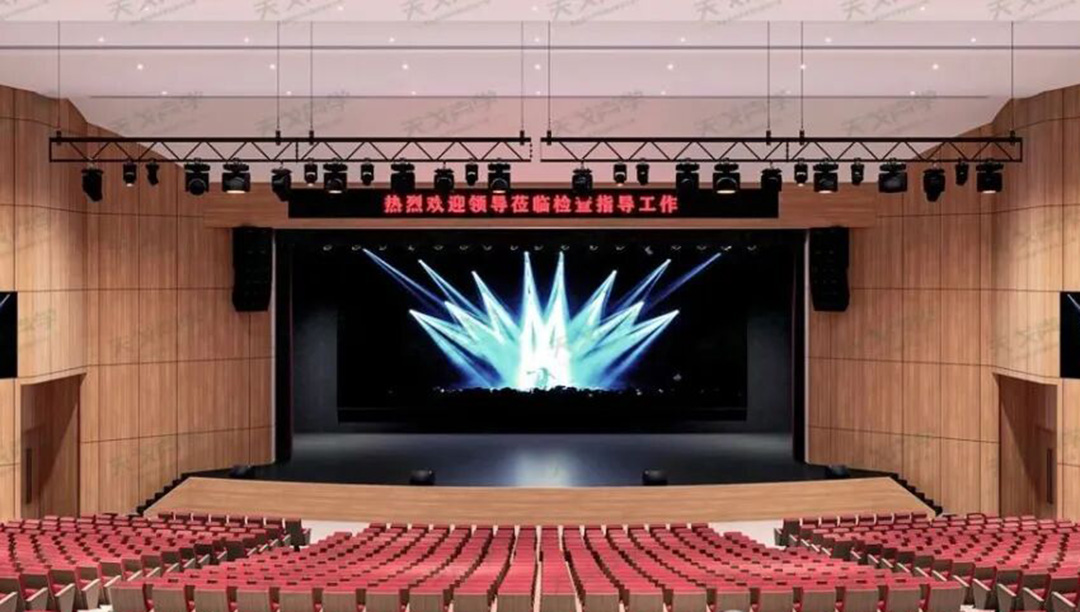
Material Properties and Functions
Flame-retardant fabric acoustic panels and perforated
acoustic panels are both sound-absorbing materials, primarily used to control echoes. In auditoriums, echoes can cause sound to become muddy and unclear, affecting speech intelligibility and overall sound quality. These two materials, through different sound-absorbing principles, effectively reduce sound reflections, thereby improving the acoustic environment.
Acoustic Design Process
Sound Field Testing and Determination of Expected Effects: First, a comprehensive sound field test was conducted in the auditorium to understand its existing acoustic characteristics. Through thorough communication with relevant personnel, the expected effects to be achieved in the auditorium were clarified. Unless otherwise specified, the acoustic design was carried out in accordance with the national standard "Code for Sound Insulation Design of Civil Buildings" GB50118-2010 to ensure compliance with national standards.
Determine acoustic parameters and material usage: Based on the acoustic design results, determine the various acoustic parameters of the auditorium, such as reverberation time and speech intelligibility. Based on these parameters, accurately calculate the required amount of sound-absorbing material. The amount of sound-absorbing material directly affects the sound quality; an appropriate amount will generally guarantee good sound quality.
Design, finish, and decorative elements: After determining the amount of sound-absorbing material to be used, the next step is to consider the material's shape, finish, and its combination with other materials. TianGe Acoustics' designers will provide clients with a variety of successful designs from previous venues for reference. Based on the client's needs and the actual conditions of the auditorium, a final design scheme will be determined, and detailed drawings and renderings will be produced.

Key Points for Combining Flame-Retardant Fabric Acoustic Panels with Perforated Acoustic Panels
Functional Zoning: The layout should be designed according to the functional needs of different areas in the auditorium. For example, in areas where speech intelligibility is crucial, such as the podium and the front of the audience seating, the amount of perforated sound-absorbing panels can be increased. Perforated acoustic panels have good mid-to-high frequency sound absorption performance, effectively reducing echoes in these areas and improving speech intelligibility. Flame-retardant fabric acoustic panels can be used around the walls and in corners. Flame-retardant fabric acoustic panels not only has a certain sound absorption effect but also serves a decorative purpose. Its soft texture also prevents excessive sound focusing in corners, improving the sound field distribution.
Frequency response matching: Considering the characteristics of sound in different frequency bands, targeted matching is employed. Perforated sound-absorbing panels are highly effective at absorbing mid-to-high frequency sounds, while flame-retardant fabric acoustic panels have a certain absorption and diffusion effect on low-frequency sounds. Therefore, combining the two allows for effective control of sound across the entire frequency range, resulting in a more balanced and natural acoustic quality in the auditorium. For example, in a large auditorium, to control low-frequency reverberation, flame-retardant fabric acoustic panels can be installed at the bottom of the walls, while perforated acoustic panels are installed at the top, forming a sound-absorbing structure that balances high and low frequencies.
Combining Aesthetics and Practicality: The design process should balance aesthetics and practicality. Flame-retardant fabric acoustic panels offer a wide range of colors and styles, allowing for personalized designs to match the overall décor of the auditorium and create a comfortable and beautiful environment. Perforated acoustic panels, on the other hand, can be coordinated with flame-retardant fabric acoustic panels through various finishes such as wood, metal, and fabric, simultaneously fulfilling the dual needs of sound absorption and decoration. For example, in a modern auditorium, white or gray perforated sound-absorbing panels can be paired with flame-retardant fabric acoustic panels featuring simple patterns, ensuring both acoustic performance and enhancing the aesthetics of the space.
Construction Arrangement and Results Guarantee
After determining the combination of flame-retardant fabric acoustic panels and perforated acoustic panels, a professional manufacturer is arranged to produce them, and a detailed installation plan is developed. During construction, strict adherence to design requirements and construction specifications is crucial to ensure accurate and secure installation of materials, tight joint treatment, and prevention of sound leakage. A professional construction team, with its rich experience and excellent skills, can ensure that the flame-retardant fabric acoustic panels and perforated acoustic panels fully utilize their sound absorption performance to achieve the desired acoustic effect.
In summary, the proper combination of flame-retardant fabric acoustic panels and porous sound-absorbing panels in the acoustic decoration of an auditorium requires comprehensive consideration of acoustic design, functional requirements, frequency characteristics, and aesthetics. Through scientific combination and professional construction, a high-quality acoustic environment can be created for the auditorium, meeting the needs of various events.